
Museo Nómada de la Fotografía
Falsos lugares perfectos
Fàbrica Cal Garbat
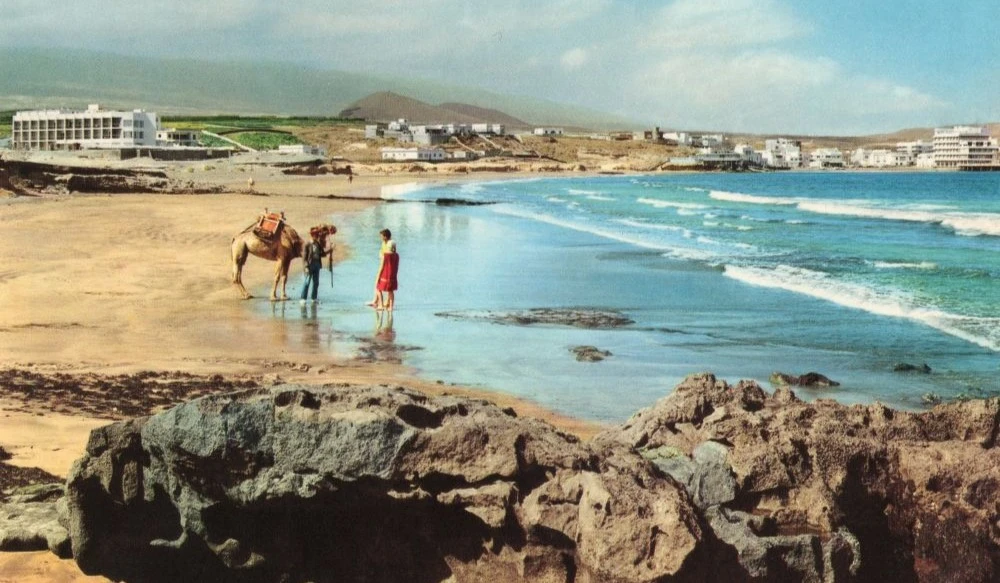
Postcards serve as narratives of the traveller’s memory, as they evoke realms of happiness and well-being – ideal places where everything is perfect, where everything is designed to satisfy the needs of those escaping from everyday reality. For this reason, postcards are nothing more than visual promises of a promised land, signs and assurances of a paradise created to fulfil the experiences and dreams of tourists.
As a traditional destination for European tourism since the late 19th century, the Canary Islands have reinforced their status as a fortunate destination, promoting their unique climate and landscapes through advertising with the aim of constructing a distinct imaginary that recreates and reinforces this tourist-oriented, paradisiacal fiction of the archipelago.
The exhibition False Perfect Places explores the processes behind the creation of the photographic and tourist image of the Canary Islands through a critical analysis of three different editorial projects linked to three distinct historical periods: the collection of photographic postcards produced by the German photographer Otto Auer (1920s and 1930s); the works of the French ‘landscape photographer and art editor’ Philippe Martin (1950s and 1960s); and the collection of Canarian postcards published by John Hinde Studios in Dublin (1970s).

The Nomadic Museum of Photography (Tenerife, 2025) is an alternative, community-based and independent museum project developed by Carmelo Vega de la Rosa and José Maria Mercader, which proposes new ways of researching, collecting and disseminating photography.
With no fixed premises or walls, it functions as a repository of ideas, activities and materials linked to the history of photography, from its origins to the present day.
Through dialogue between diverse collections, it offers a critical and transdisciplinary interpretation of photography as a historical, aesthetic and cultural phenomenon.